
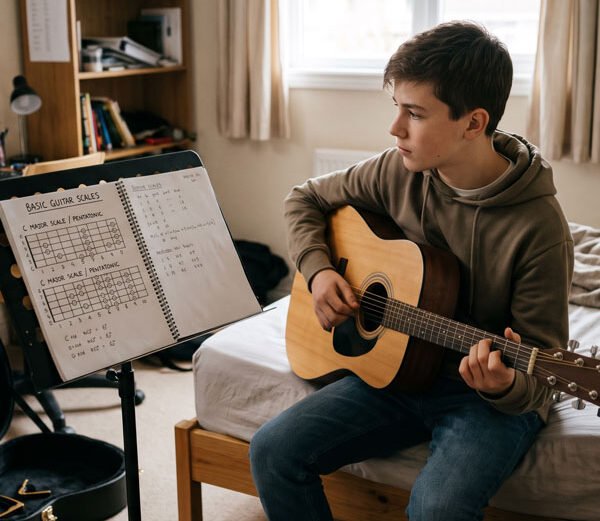
Learning basic guitar scales builds finger strength, fretboard familiarity, and the foundation for playing melodies, riffs, and solos. Rather than memorizing random notes, beginners can rely on movable patterns that work anywhere on the neck.
Why Scales Matter
- Finger Dexterity & Coordination: Practicing scales trains your fretting hand and picking hand to work in sync while stretching your fingers comfortably across frets.
- Ear Training: Playing ascending and descending scales teaches your ear how musical intervals relate to one another.
- Solos & Improvisation: Scales give you a reliable “map” of notes that sound good over specific chord progressions.
3 Essential Scales to Start With
- The Minor Pentatonic Scale: The most popular scale for rock, blues, and pop soloing. It uses just five notes per octave and has an intuitive “box” shape (Position 1) that is easy to memorize and move up and down the fretboard.
- The C Major Scale (Open Position): Built from the seven natural notes (
C – D – E – F – G – A – B) with no sharps or flats, making it ideal for understanding basic music theory and learning notes near the headstock. - The Natural Minor Scale: Shares the exact same notes as its relative major scale (for example, A Minor uses the same notes as C Major) while offering a darker, more emotional sound.
Quick Practice Tips
- Use One Finger Per Fret: Assign your index, middle, ring, and pinky fingers to four consecutive frets to minimize unnecessary hand movement.
- Alternate Picking: Practice picking down on the first note and up on the next (
D - U - D - U) to build speed and efficiency cleanly. - Start Slow with a Metronome: Focus on crisp, buzz-free notes at a slow tempo before gradually increasing your speed.