
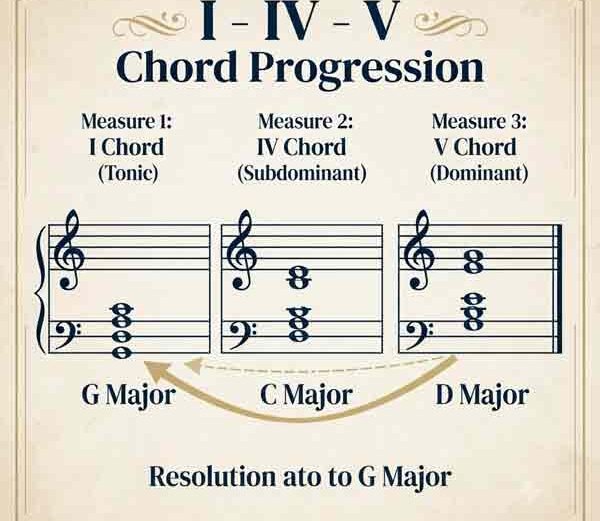
A chord progression is simply a sequence of chords played in a specific order to create the harmonic foundation of a song. Most beginner-friendly songs rely on just three or four chords—like G – C – D or C – G – Am – F—because their notes naturally blend together to create a sense of movement, tension, and resolution.
Smooth chord transitions (switching from one chord to the next without stopping the rhythm) are the biggest early hurdle on guitar, and building muscle memory is the key to overcoming it:
- Use Anchor Fingers: Look for notes two chords share. For example, when switching from C major to A minor, your index and middle fingers stay planted in the exact same spots—only your ring finger moves. Keeping anchor fingers down stabilizes your hand and cuts down movement.
- Keep Your Fingers Close: Avoid lifting your fingers high off the fretboard between changes. Hover just a millimeter above the strings so you can drop straight into the next shape.
- Move All Fingers Together: Beginners often place their index finger down first, followed one-by-one by the middle and ring fingers. Practice forming the entire chord shape in mid-air so all fingers land on the fretboard simultaneously.
- Prioritize Rhythm Over Perfection: When practicing with a strumming pattern, keep your strumming hand moving steadily even if your fretting hand is a split-second late. Pausing to fix a finger breaks the groove, while staying in time trains your hands to speed up naturally.