
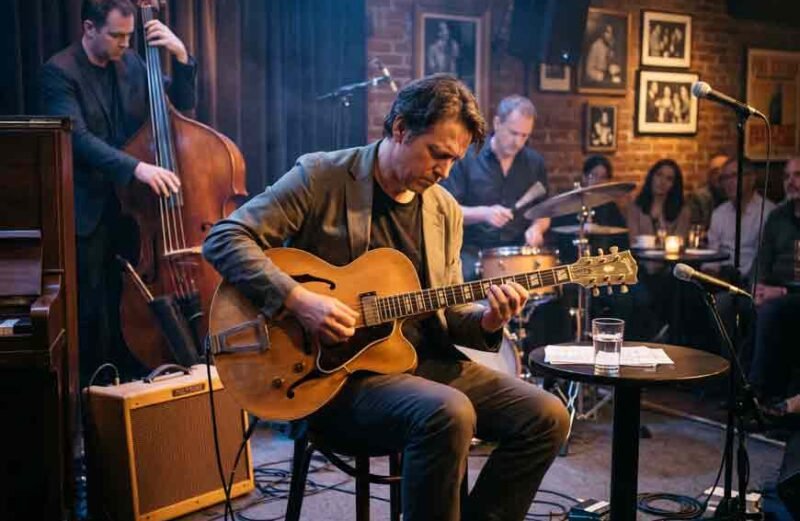
The Art of the Moment: What Makes a Great Jazz Song?
Unlike pop or rock, where the studio recording is treated as the definitive version of a song, a jazz track is best understood as a blueprint for a live conversation. Rooted in African American communities in New Orleans at the turn of the 20th century, jazz transformed Western music by shifting the focus from strict notation to real-time creation.
Whether it is the brassy swing of a 1930s big band, the blistering speed of bebop, or the spacious, atmospheric cool of the late 1950s, the greatest jazz songs balance structural discipline with total freedom.
The Core Elements of Jazz
-
Improvisation: The heartbeat of the genre. Musicians state a main melody (known as the “head”) at the beginning and end of a song, while the middle is dedicated to spontaneous solos built over the song’s chord progression.
-
Swing and Syncopation: Instead of playing eighth notes with rigid, mechanical equality, jazz musicians play them with a lilting, uneven bounce—a rhythmic feel called swing. Syncopation places accents on unexpected off-beats, giving the music its forward momentum.
-
Extended Harmony: Where rock and pop often rely on three-note triads, jazz builds lush, complex chords using 7ths, 9ths, 11ths, and 13ths. These added tensions create rich emotional colors that give soloists wider melodic pathways to explore.
-
Call-and-Response: Derived from blues and gospel traditions, band members constantly react to one another. A pianist might drop a rhythmic chordal “comp” in direct answer to a saxophonist’s phrase, turning the performance into an active dialogue.
Essential Tracks That Define the Sound
To hear how jazz evolves across moods and eras, explore these five foundational recordings:
| Track | Artist | Era / Style | Why It Works |
| “So What” | Miles Davis | Modal Jazz (1959) | Replaces rapid chord changes with slow, spacious scales, letting every single note breathe with effortless cool. |
| “Take Five” | The Dave Brubeck Quartet | Cool Jazz (1959) | Built on an unusual 5/4 time signature, driven by a hypnotic piano vamp and Paul Desmond’s silky alto saxophone. |
| “Sing, Sing, Sing” | Benny Goodman | Swing (1937) | An explosive big-band showcase propelled by Gene Krupa’s thunderous tom-tom drum solo and blazing brass sections. |
| “A Love Supreme, Pt. 1: Acknowledgement” | John Coltrane | Spiritual / Post-Bop (1965) | Centers on a simple four-note bass motif that Coltrane transposes through all twelve keys in an intense, meditative build. |
| “Autumn Leaves” | Cannonball Adderley (feat. Miles Davis) | Hard Bop (1958) | A masterclass in melodic storytelling, showing how two horn players with contrasting styles can elevate a classic standard. |
Why the Genre Endures
Jazz rewards active listening. Because no two performances of a jazz standard are ever identical, the genre captures the raw, unedited human spirit in real time. You aren’t just listening to a finished product—you are listening to musicians taking risks, solving harmonic puzzles on the fly, and finding beauty in the unexpected.